
Medical Device Innovation Center
Pohang University of Science and Technology
Intern Recruitment
Developing an Implantable Device for Adaptive Neuromodulation

Adaptive neuromodulation is a novel approach for next-generation treatment of neurological disorders. We are developing an implantable device that can analyze biosignals in real time and dynamically control electrical stimulation using embedded intelligence such as lightweight AI models.
-
Relevant fields: Electrical Engineering, IT, etc.
-
Required skills: PCB design, system design, CAD design, programming (C, Python, HDL, etc.)
-
Related paper: Hoang et al., Fully wireless implantable device capable of multichannel neural spike recording and stimulation for long-term freely moving rodent study, IEEE-TNSRE, 2025
Neural Control Algorithm Development

Abnormal activity in the nervous system is a major cause of various disorders. We are developing intelligent neural control algorithm technologies that can precisely detect such abnormal activity and automatically adjust stimulation intensity in real time, thereby providing patients with optimal therapeutic effects.
-
Relevant fields: Mechanical Engineering, Electrical Engineering, etc.
-
Required skills: Optimal control, etc.
-
Related paper: Cho et al., Neuroprosthetic closed-loop strategy for sustained blood pressure reduction via simultaneous stimulation and recording from the spinal cord, Neurotherapeutics, 2025
Flexible Neural Interface Development

Human nerves operate through electrical signals. Therefore, neural activity can be regulated by applying external electrical signals. A flexible neural interface is an electronic device directly connected to nerves and serves as a key component of neuromodulation systems.
-
Relevant fields: Mechanical Engineering, Materials Science and Engineering, etc.
-
Required skills: Mechanics of materials, CAD, finite element analysis, etc.
-
Related paper: Hong et al., Unidirectional dynamic stiffness modulation enables easily insertable and conformally attachable spinal bioelectronic device, npj Flexible Electronics, 2026
Modeling Physiological States Based on Neural Population Dynamics

Physiological responses are closely associated with neural signals.
We aim to model physiological state transitions based on the dynamics of neural population activity derived from electrophysiological signals, and to predict these physiological states.
Through this approach, we seek to understand complex neural system state transitions in a structured manner and ultimately contribute to the development of digital twin-based models.
-
Relevant fields: Electrical Engineering, Computer Science, Biomedical Engineering, etc.
-
Required skills: Signal processing, data analysis, machine learning, etc.
-
Related paper: Lee et al., Predictive modeling of hemodynamics during viscerosensory neurostimulation via neural computation mechanism in the brainstem, npj Digital Medicine, 2025
Audiovisual Stimulation for
Addiction Circuit Analysis and Treatment
Drug addiction manifests through abnormal neural responses. This study aims to understand addiction dynamics by analyzing neural signals and behavioral responses using frequency-specific audiovisual stimulation. Electrophysiological data (FSCV), electrophysiological recordings, and behavioral experiments are integrated to investigate addiction-related changes. Through this approach, we aim to comprehensively understand changes in reward circuits and cortical dynamics and ultimately derive mechanisms for addiction treatment and prevention.
-
Relevant fields: Electrical Engineering, Biomedical Engineering, Bioinformatics, etc.
-
Required skills: Fabrication, multi-modal data analysis, optimization theory, etc.
-
Related paper: TBA

RL-Based Fully Closed Loop Artificial Pancreas System

Conventional artificial pancreas systems (APS) require manual inputs and use model-based control, limiting personalization. To overcome this, we developed a reinforcement learning-based fully closed-loop algorithm. By integrating CGM trends with insulin injection history, the system automates patient's meal and insulin sensitivity for intervention-free glycemic control and realizes data-driven, personalized insulin regulation.
-
Relevant fields: Computer Science, Artificial Intelligence, Pharmacokinetics, Biomedical Engineering, etc.
-
Required skills: Reinforcement learning (RL), Data Analysis, AI Modeling, etc.
-
Related paper: Rachim et al., Generalized reinforcement learning control algorithm for fully automated insulin delivery system, Expert Systems With Applications, 2025
Automatic Meal and Exercise Detection with Lightweight On-Device AI

For accurate diabetes management, it is important to know when people eat or exercise, but manual logging is cumbersome and often incomplete. To address this issue, we are developing an energy-efficient smartwatch- and smart-glasses-based system that can automatically detect meal and exercise events in daily life. The information obtained through this system can later be used for blood glucose prediction, insulin control, and personalized decision support.
-
Relevant fields: Computer Science, Artificial Intelligence, Biomedical Engineering, etc.
-
Required skills: Computer Vision, AI Modeling and Model Compression, and Time-Series Signal Processing , etc.
-
Related paper: TBA
AI for Dietary Management
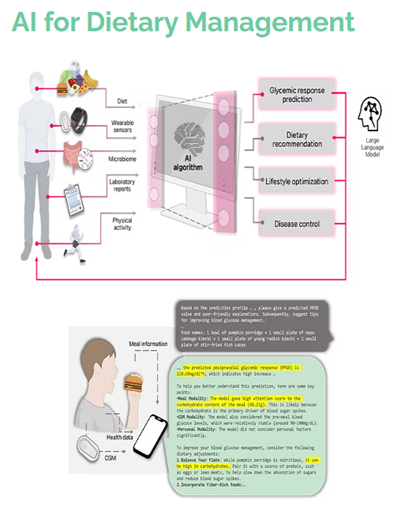
Diet plays a crucial role in maintaining health and managing chronic diseases. Our research utilizes artificial intelligence to deliver personalized dietary management solutions. By leveraging large language model (LLM), we offer real-time nutrient analysis, dietary coaching. Through this, we aim to support individuals in building healthier habits and improving their quality of life.
-
Relevant fields: Computer Science, Artificial Intelligence, Food and Nutrition, Biomedical Engineering, etc.
-
Required skills: Natural Language Processing (NLP), Data Analysis, AI Modeling, etc.
-
Related paper: Jeong et al., Enhanced Post-Prandial Glycemic Response Prediction in Type 2 Diabetes with Microbiome Data and Deep Learning, IEEE-JBHI, 2026